Demersus Devlog #9 - Finalizing the Direction
Getting back to work, finalizing the game's direction, issues in-between and future milestones.
- reading time
- 6 minutes
- published
- authors
- Eryk Darnowski
- series
- Demersus Devlogs
- categories
- Game Development
- tags
- #Ztgk #Unity
Coming Back
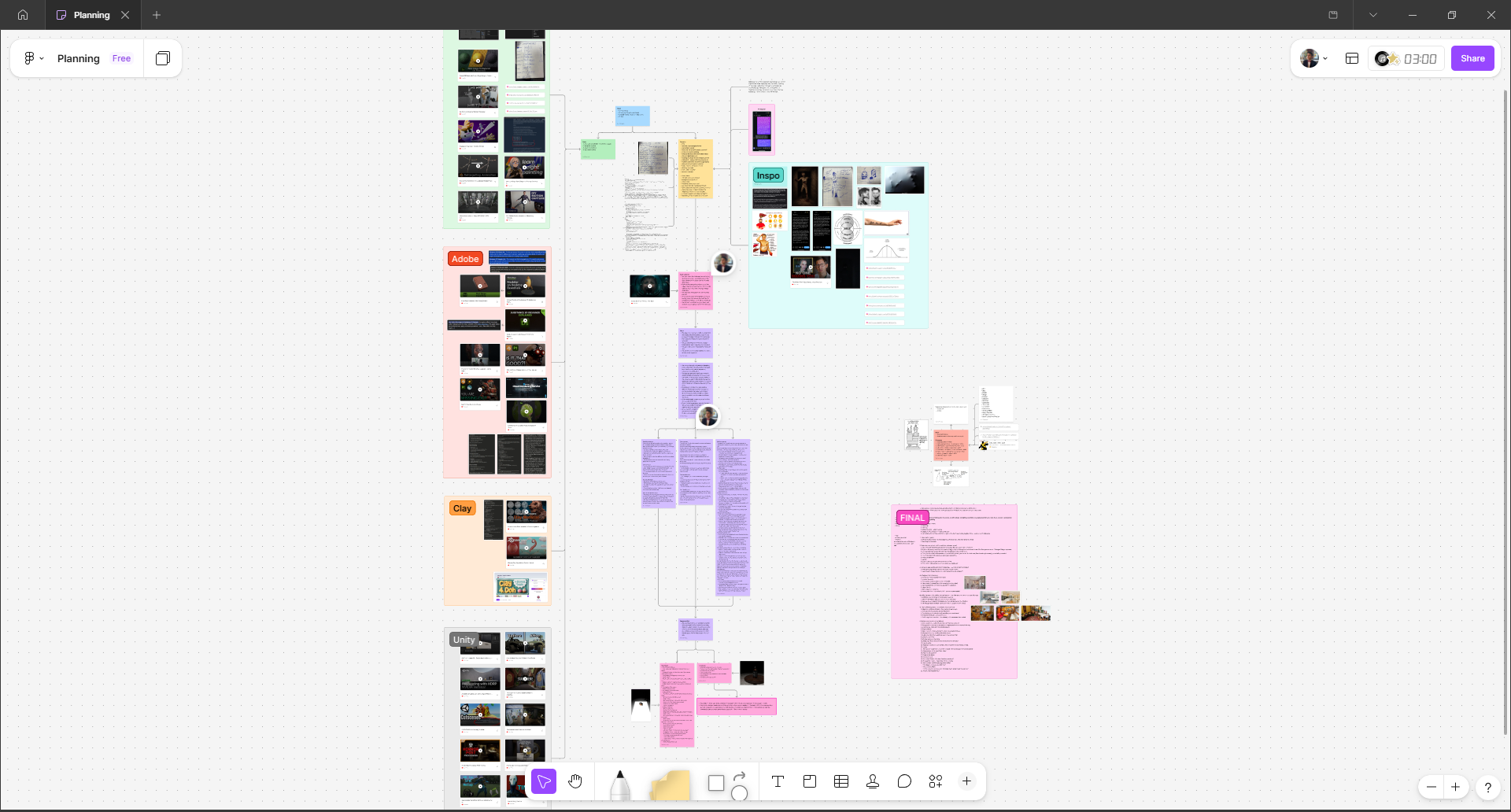
After finishing the remainder of my break, in order to get back in to the swing of things with development, I decided to create a ‘jamboard’ using Figma so me and my bud can more easily collaborate and planning the Demersus without the mess that Discord brings (the tool we mainly used as a dumping ground for links up to this point).
Taking Time for Inspiration
Sadly, having a general idea, a vision (if you will), is not enough to build a game. You need a blueprint, like a TODO list of sorts, one you can have sanity checks with and a general guide on how to approach things moving forward. Up till now that was the thing we lacked the most (it was also something that was causing me the most stress in all off this).
That was the first thing I decided to tackle. The both of us put down a few game and movie titles to check out, analyse and look in to (things like: RE7, SH2, SOMA, Visage, Amnesia, Still Wakes the Deep, Żółty szalik etc.). We gave ourselves about a week to go through them and additional pieces of media if we find more that are interesting and relevant to the project.
The Struggle of Marrying Ideas with Mechanics
Sadly I have to admit that for most of the time allocated towards gathering inspiration I was stressing out about creating a cohesive experience. I already had a vision in mind, what I wanted to achieve, but turning that in to a game is a whole new beast.
For example, at the very initial (very rough) planning meetings we had, some ideas that were thrown about (and can probably still be found in the earlier devlogs ) were:
- an FPS / gun / shooting mechanic
- a monster that is more present and you actually get to fight
- a monster SCP like ‘cognito-hazard’ QTE / button smash sequences (hallucinations)
- a drinking mechanic that would balance out certain aspects of gameplay and would decide the ending
However, the more I thought about the, the story I want to tell and what I liked and disliked in horror games I played in the past I noticed that none of these elements will fit.
For a while I fought with my thoughts thinking “this won’t be enough” and similar things, thinking that the game might be too simplistic - a walking sim. However when I looked back at horror games I played in the past I’ve noticed certain things. For example:
- SOMA - even though it has a great story, characters and environmental storytelling I feel like it’s weakest part is the ‘hunter’ sequences (which also seems to be a gripe of a chunk of it’s players base) and even lead to the addition of the ‘Safe Mode’ .
- Resident Evil (series) - again, great story, characters, animations and so on but now matter how you put it, they’re more action games because of the guns and other weapons.
- Silent Hill 2 RE - same thing, incredible story, characters, animation and most importantly a hauntingly captivating ambiance that I feel is a bit disturbed by the admittedly clunky combat (although not as bad as in the original, this is something the player base also mostly sees as an overall negative).
These revelations, a few talks with close friends and finally another meeting with my bud reassured me in the approach we should be taking with the direction of Demersus. I knew that forcing these things in would degrade the story, meaning and what the experience is supposed to represent overall even if it made the project more simple (we sadly also have to take in to account that there’s only the two of us here, not a lot of time or money, no 50 person studio or anything like that).
Final Decision and Approach to Direction
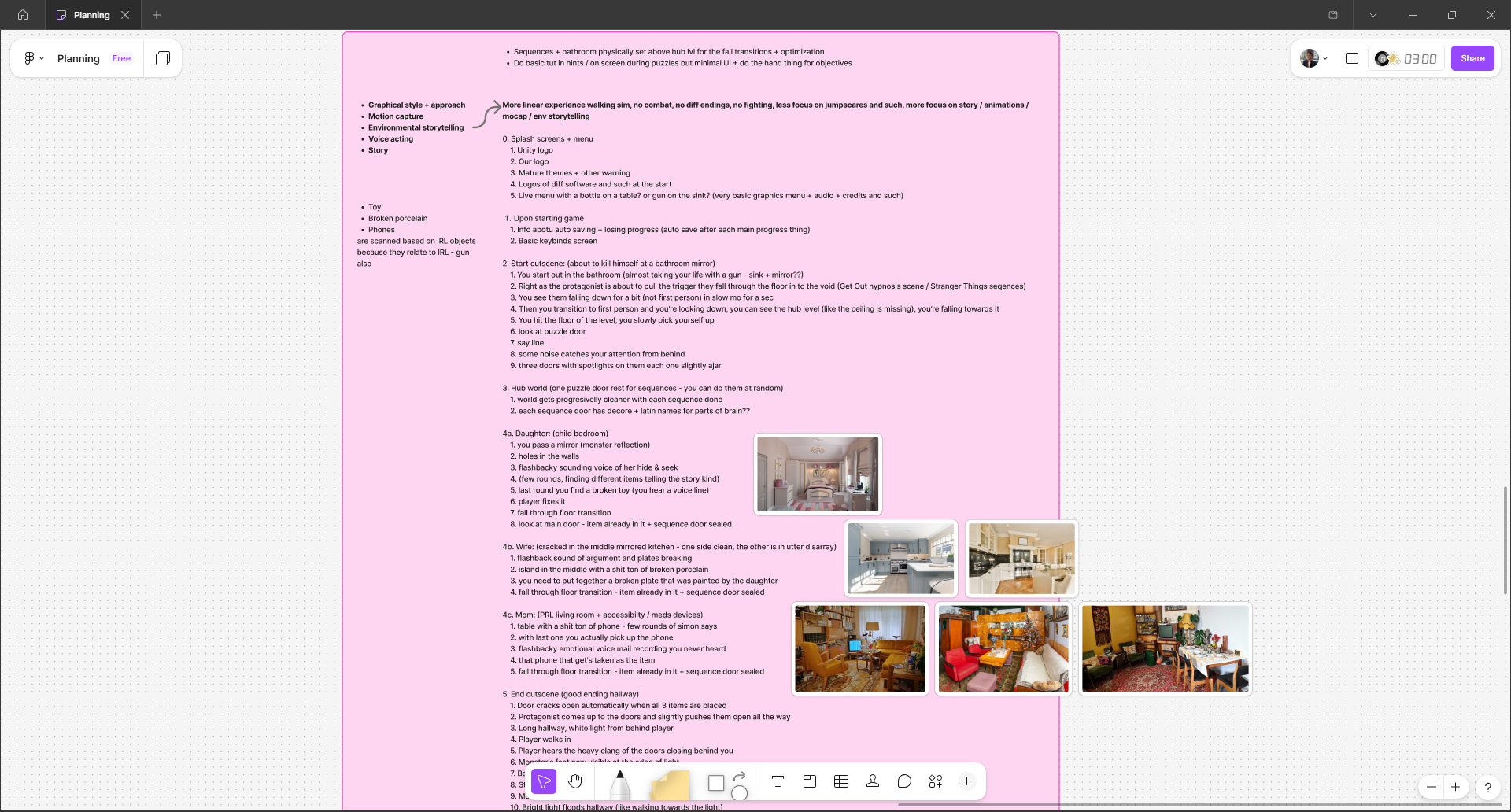
In the end after a whole bunch of brain storming, worry, research and such we both agreed on going with this very approach:
- Start cutscene (the player is kind of thrown on deep waters right away)
- We transition to the hub world
- 1x ‘puzzle’ door with 3 indents for key items
- 3x doors leading to sequences (one for each family member)
- Sequence rooms
- Daughter
- Wife
- Mom
- End cutscene
The game starts out with an emotional cutscene (motion capture + voice acting) where the protagonist is about to shoot themselves in the bathroom. However before they manage to do so, they start falling through the floor (cinematic transition), after that, the cutscene transitions seamlessly to the first person camera and the player sees the hub world getting closer and closer as they fall towards it.
Finally the hit the floor, pick themselves up and notice the puzzle door, the protagonist says something and then a noise from behind catches their attention (they notice all of the sequence doors). The hub world is supposed to signify the addiction in the protagonist’s psyche, this level will be dirty at first and witch each sequence done (they can be played in non-linear order) it progressively gets cleaner as does the protagonist.
Each sequence is heavily stylised (this is where the environmental storytelling shines). They signify a certain ‘scar’ / unresolved issues of the protagonist witch their family members. The sequences have a unique style, sound and most importantly gameplay element to them, featuring puzzle elements that deeply reflect each person. That’s how the protagonist finds ‘keys’ to the puzzle door.
The end sequence is what follows after all of the key items are installed in the door, the player opens the door fully, goes in, and meets the monster (the personification of his addiction) eye to eye, there is an exchange that follows, the monster disappears with a screech, there is a dip to white, a transition back to the very first environment. The protagonist decided against going through with suicide and called back their mom, we hear and exchange as the screen fades to black and the credits come on.
This is a more or less detailed plan we have for the game’s direction.
The Milestones
Here are our current, roughly devised milestones for the project:
| Task | Date |
|---|---|
| Inspiration phase | 15.02.2026 |
| Full (rough) prototype | 20.02.2026 |
| Clay material + geometry for walls and such | 27.02.2026 |
| 3D scans + models + proper levels | 20.03.2026 |
| Cutscenes + animations + notes and such | 03.04.2026 |
| Music + SFX + voice acting + UI + subs | 17.04.2026 |
| Menu + polish | 01.05.2026 |
| Cinematic trailer | 14.05.2026 |
What’s Next?
The most important thing currently (as the milestone table would imply) is the rough prototype (rough meaning - no cutscenes ; animations ; textures and such). I’ll try to setup tests for all of the ‘puzzles’ in each sequence (hide & seek ; porcelain and phones) and my bud will take care of doing a rough block out of the hub world and three sequence rooms (omitting the bathroom and final hallway for start and end cutscenes).